Mistaking a first reaction for a final judgment
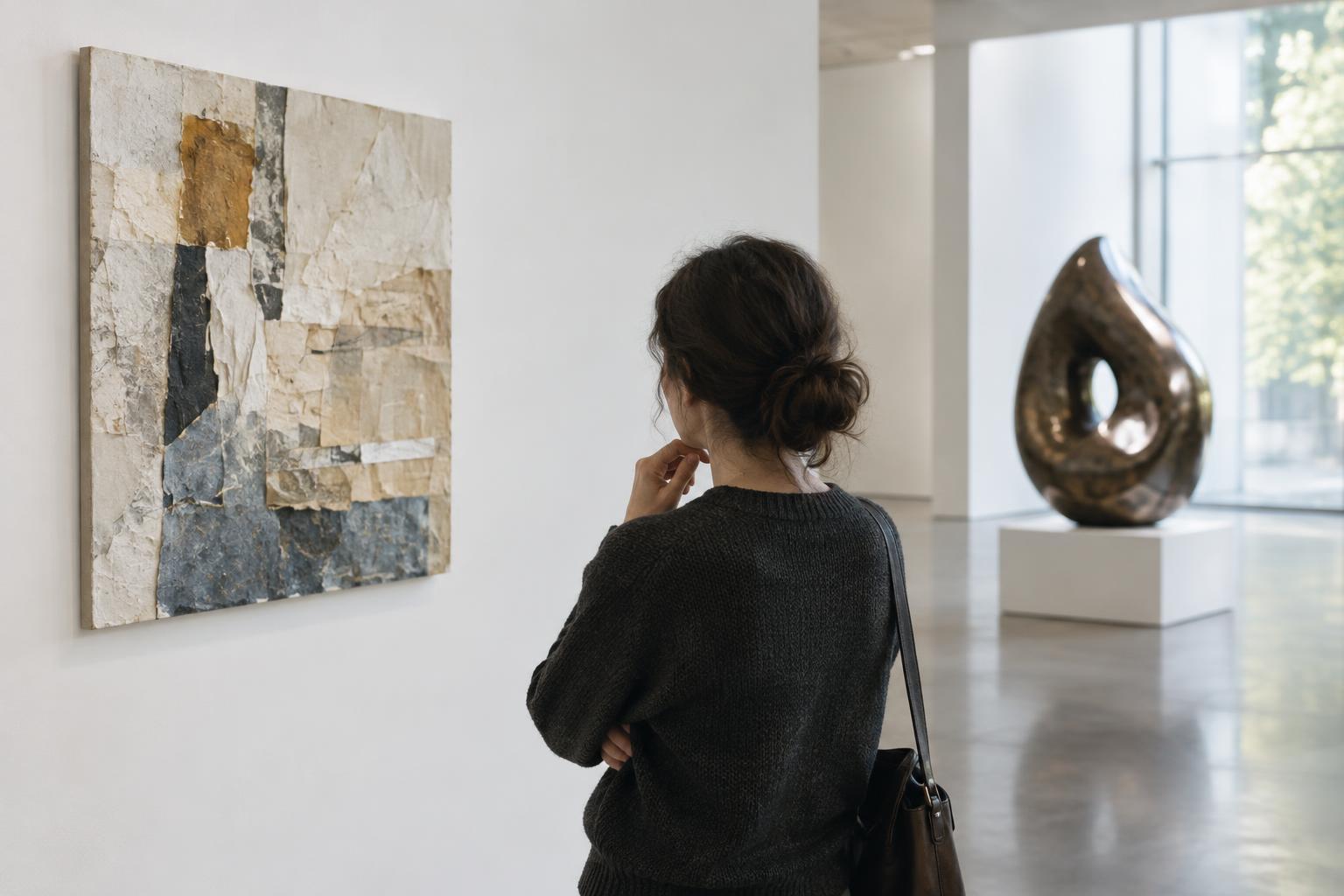
“I like it” and “I don’t get it” are honest responses, but they are starting points rather than complete accounts of an artwork. A work may be deliberately quiet, awkward, playful or difficult to read at first. If the conversation stops at an immediate reaction, there is little room to notice how the work operates or why someone else might experience it differently.
Try following your reaction with an observation. What caught your attention first: scale, color, sound, movement, texture or placement? Did your impression change as you spent time with the work? Saying “I found the room unsettling because I couldn’t tell where the sound was coming from” gives others something specific to discuss. You can remain unconvinced while becoming clearer about what, exactly, did not work for you.
Assuming every work has one hidden meaning
It is easy to treat contemporary art as a puzzle with an answer held by the artist or the wall label. Context can matter: a title, a material choice or an exhibition text may change what you notice. But context does not always reduce a work to a single message. An installation might prompt questions about domestic space, memory and movement at the same time, without requiring every visitor to arrive at an identical interpretation.
Instead of asking only “What does it mean?”, ask “What does it do?” Consider how the work directs your attention, where it asks you to stand and what connections its parts invite. Then separate what you can observe from what you infer: “The chairs face away from the screen” is an observation; “That may suggest a refusal to watch” is an interpretation. The distinction makes discussion more open, not less thoughtful.
Confusing unfamiliar materials with a lack of skill
A common response to a modest-looking object is “Anyone could make that.” It can be a useful question if it leads to closer examination, but it often ends the conversation too early. Skill in contemporary practice may involve selecting, arranging, testing or adapting materials rather than displaying a familiar technique. An ordinary object can also behave differently when it is repeated, suspended, lit or placed in relation to a particular room.
Look at the decisions visible in the work before judging their success. Why might an artist leave a surface rough or allow a material to sag? What changes if a fragile object is set beside an industrial one? You do not have to admire every choice. Describing those choices lets you say more than “It looks easy”—and may help you explain why a work feels precise, careless or somewhere in between.
Talking about an installation as though it were only an image
Photographs can help document an artwork, but they may flatten an experience built around space. In an installation, the distance between objects, the path through a room and the time spent listening or looking may be central to the work. The same is true of some art in public spaces, where passersby, weather and surrounding architecture can affect what a person notices.
When discussing a spatial work, include your position in the account. Could you walk around it? Did a doorway frame your first view? Were there areas you could not enter? If you encountered the work only in a photograph, say so. This is not a lesser form of conversation, but it helps to be clear about which parts of the experience the image can show and which it leaves uncertain.
Treating disagreement as a test of who belongs
People sometimes worry that questioning a work will make them seem uninformed, while others feel pressure to dismiss it before someone can explain it to them. Neither approach leaves much space for conversation. Familiarity with art terms can be useful, but it is not a requirement for noticing something worth discussing. Likewise, an artist’s stated intention need not settle whether a work is effective for every viewer.
A better exchange makes room for both evidence and difference. Ask another person what they noticed before offering a counterargument, and point to features of the work when explaining your view. “I read the empty space as calm; what makes it feel tense to you?” invites a response. The goal is not to produce a unanimous verdict. It is to leave with a more attentive account of the work than either person had on arrival.