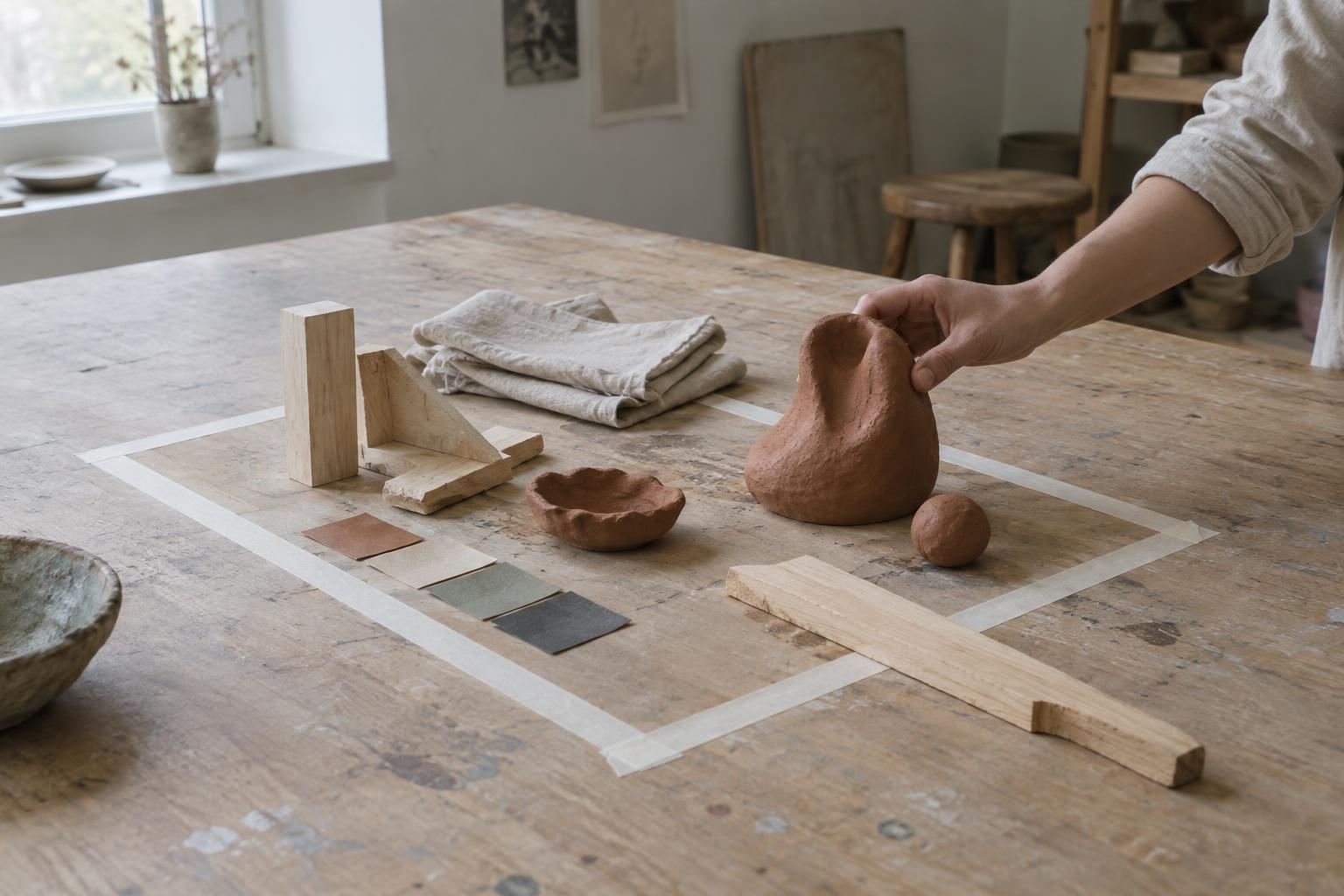
A constraint is a decision, not a virtue
A creative constraint narrows the choices available while making an artwork. It might be self-imposed, such as using only found paper, or imposed by a situation, such as a small exhibition room. Either kind can help an artist begin. Instead of asking what could be made from every possible material, the artist can ask what this paper can do, how it bends, and what happens when it is displayed.
Limits are sometimes praised as though difficulty automatically produces stronger work. It does not. A useful constraint directs attention toward questions the artist wants to investigate. An unhelpful one consumes energy without deepening the work. The difference may only become clear through making, so it helps to treat a constraint as a working decision rather than a rule that must be defended at all costs.
How limits can open up a process
Constraints can make experimentation more specific. An artist working with one repeated shape can change its scale, spacing, surface or orientation and see each variation more clearly. Someone making a sound installation with a single speaker may pay closer attention to where a listener stands and how sound travels through the room. Fewer variables can make small decisions easier to notice.
A limit can also connect form to meaning. Reusing packaging might support a work about circulation and waste, while restricting an installation to materials that can be carried by hand might make portability part of its character. The connection is strongest when the limitation affects what a viewer encounters, not just the story told about how the work was made.
Time limits can be useful for studies, too. A brief making session may encourage an artist to test an uncertain idea before investing in a finished piece. The result does not have to be exhibited. It can reveal which questions deserve more time.
When a productive limit becomes an obstacle
A constraint stops helping when maintaining it matters more than observing the work. If a fragile material repeatedly fails in an installation, the failures may be worth exploring—or they may prevent the intended encounter from taking place. Likewise, a rule to use only one color might sharpen attention to texture at first but eventually flatten distinctions the artist needs.
Some limits have consequences beyond the maker’s intentions. A rigid display plan might block comfortable movement through a space. An unnecessarily demanding schedule can leave too little time to test how a work is installed or understood. These are not signs that the artist lacks commitment. They are reasons to examine whether the chosen rule still serves the project.
It is also worth distinguishing a self-chosen experiment from a restriction imposed by limited resources or access. An artist may find inventive responses to a small budget or an unsuitable room, but that does not make the barrier desirable. Naming the difference keeps the discussion of creative limits honest.
Test the rule before building around it
Start by stating the constraint in ordinary language: “I will use one kind of material,” or “The work must be viewable from the doorway.” Then name what you hope it will help you notice. This second step gives you a way to evaluate the rule. If a doorway view is meant to emphasize distance, make a quick mock-up and look at it from that position. Does distance become meaningful, or does the work simply become hard to see?
Small tests are especially valuable for spatial work. Place temporary forms in a room, walk around them and consider how they relate to light, entrances and other people’s movement. For an image-based work, try several versions with the same limitation and compare what changes. Keep notes on surprises, including moments when you wanted to break the rule. That impulse may point to a weakness in the constraint or to an interesting tension within the work.
Revise without losing the question
Changing a constraint does not mean abandoning an idea. An artist who begins with only discarded cardboard might later add fasteners to make an installation stable while keeping the cardboard’s worn surfaces central. A strict repetition might become a sequence with one interruption. Such changes can make the original question more visible.
After a test, ask what the limit made possible, what it hid, and who or what had to accommodate it. Keep it if those effects support the work. Adjust it if a small change would create a clearer encounter. Let it go if it mainly preserves an early plan. The aim is not to prove that limitations are good or bad; it is to choose them with enough care that they remain responsive to the work as it develops.