Representation is more than visibility
A museum can add an artist to its walls without changing the story those walls tell. If the new work is treated as an exception to an otherwise settled account of art, visitors may leave with the same assumptions they brought in. Decolonial art asks a broader question: who had the power to define the account in the first place? It examines the categories, collecting practices, and ways of describing objects that shape what audiences understand as important.
This does not mean every exhibition must tell one complete history. No exhibition can. It means acknowledging that a selection is a selection, made from a particular position. A label might identify not only an object’s materials and maker but also why it entered a collection, what remains uncertain, and which perspectives have been left out. Such details can turn a seemingly neutral display into a more honest invitation to look.
Following an object beyond the gallery
Works of art do not arrive in galleries without a past. They may have been made for use, exchange, ceremony, private viewing, or an audience very different from the one encountering them today. Asking how an object moved can illuminate relationships that a date and a place of origin cannot. Who commissioned it? Who cared for it? Who named it, and in which language? What changed when it was placed behind glass or described as art?
These questions matter especially when collections were formed amid unequal power. They should not be used to imply that every object has the same history or that its meaning can be recovered in full. Records may be incomplete, and people connected to an object may hold different views. Clear interpretation can make room for those limits rather than smoothing them away. Where appropriate, it can also explain whose knowledge informed the display and whose voices visitors are hearing.
Changing how exhibitions speak
The language of an exhibition can make some people seem like active makers and others like anonymous representatives of a culture. Compare a label that presents a work only as an example of a regional style with one that also considers an individual maker’s choices, the work’s uses, and the conditions under which its name was recorded. Neither a personal story nor a cultural context should erase the other. The aim is to avoid reducing a work to a single role.
Spatial choices speak, too. Placing objects in a tidy sequence of influence can suggest that ideas travel in only one direction. A different arrangement might reveal exchange, resistance, adaptation, or simultaneous experimentation. Audio, translation, seating, and the amount of time given to a work all affect whose knowledge feels welcome in a room. These choices do not settle difficult questions, but they make the exhibition’s point of view easier to notice and examine.
Collaboration requires more than an invitation
Inviting artists, researchers, or communities to contribute a comment can broaden an exhibition, but participation is not automatically shared authority. It matters when people are invited, what decisions remain open, how their contributions are credited, and whether they can disagree with the institution’s preferred account. Consultation that begins only after the display is designed may offer little room to shape it.
Thoughtful collaboration also resists the idea that any one person can speak for an entire community. People may disagree about an object’s meaning, public access, or appropriate presentation. Rather than asking for a single definitive voice, an exhibition can explain how decisions were made and, when participants wish, allow differing perspectives to remain visible. That approach treats interpretation as an ongoing relationship rather than a finished statement on a wall.
Looking with better questions
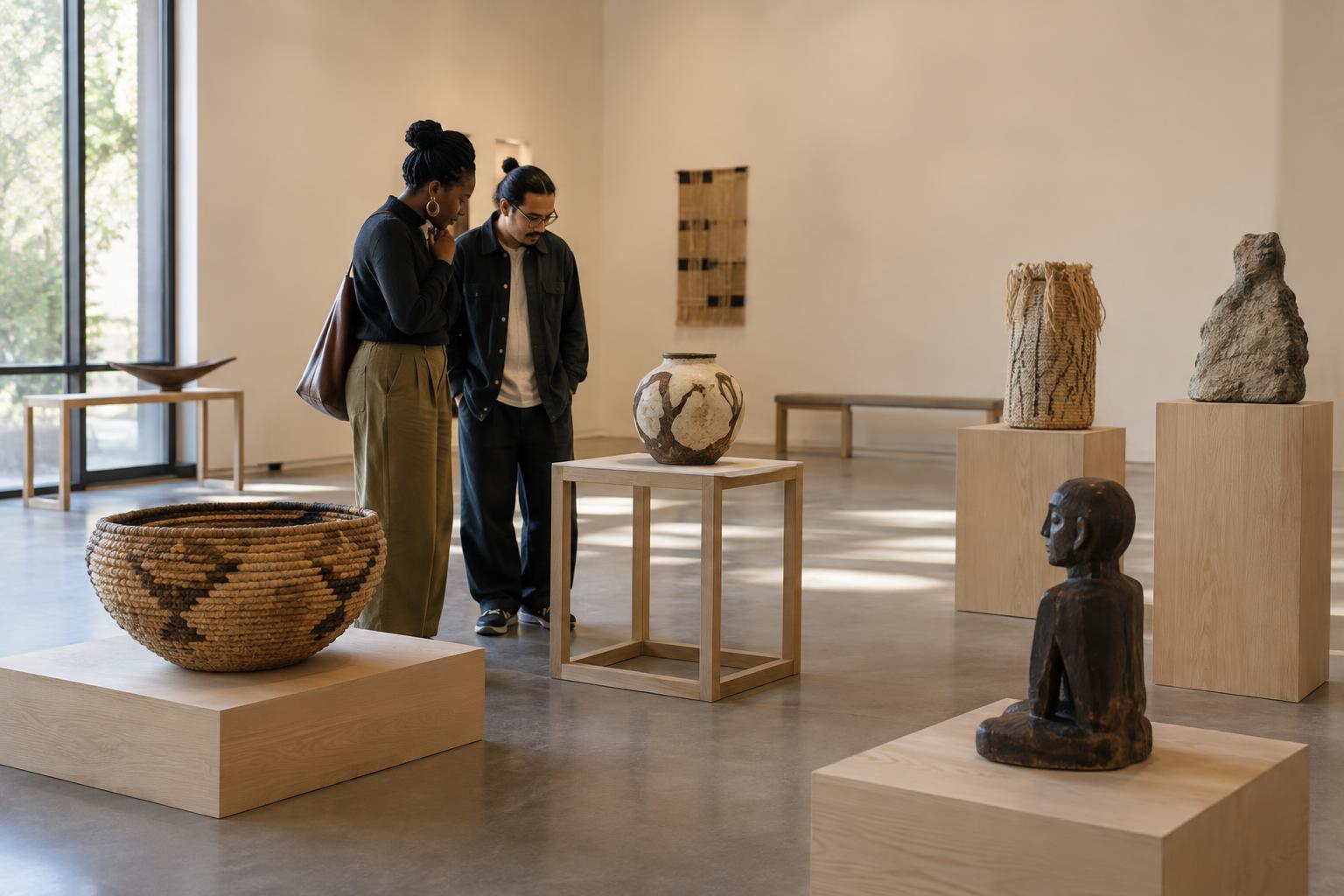
Visitors do not need specialist vocabulary to engage with decolonial art. Start with what is present: the maker named on the label, the materials, the placement of the work, and the story told beside it. Then notice what is harder to see. Is the route by which the work arrived explained? Are local or inherited forms of knowledge treated as ideas in their own right, rather than as background to someone else’s innovation?
These questions can enrich an encounter without requiring an immediate verdict on every display. Decolonial practice is not a visual style that can be spotted at a glance, nor is it a promise that a single revised label will repair a complex past. It is a way of staying attentive to how histories are assembled and to who can help reshape them. In contemporary art, that attention can open space for more precise stories—and for histories not yet fully told.