Why the distinction is useful
A projection that responds to visitors, a drawing made on a tablet and a website that changes as people use it might all be described as digital art. They do not, however, ask audiences to engage in the same way. Labels can help us notice those differences, provided we treat them as starting points rather than fixed borders.
Digital art generally refers to work in which digital tools or processes play a significant role in making or presenting the result. New media art is a broader, more flexible term often used for work that explores emerging or networked forms of communication, participation and technological experience. A work may fit both descriptions. Neither label tells us, by itself, whether the work is visually compelling, conceptually interesting or meaningful to its audience.
What makes a work digital?
The word digital points first to process. An artist might draw with software, construct a three-dimensional scene, write code, edit moving images or use a computer-controlled machine to produce a physical object. The final work need not appear on a screen. A printed image, sculpture or installation can still have a digital process at its core.
It helps to ask what the digital process contributes. If a computer is used only to arrange an exhibition checklist, calling the exhibited painting digital art would tell us little about the painting. If software shapes its image, behavior or fabrication in a way that matters to the work, the label becomes more informative. There is no universal threshold: an artist’s account and the visible features of the work can both guide the description.
Digital art also includes works that are relatively stable. A rendered image printed on paper may remain the same each time it is viewed. Its digital origin matters, but interaction or connectivity is not required.
What does new media add?
New media art often shifts attention from a particular tool to the relationships a work creates. It may examine how images circulate, how people communicate through interfaces, or how a visitor’s action changes what happens next. Websites, interactive installations, sensors, live feeds and programmed systems can all provide a setting for these questions. The phrase “new media” is historically relative: what once felt unfamiliar can become ordinary, while artists continue to find fresh uses for established tools.
Not every new media artwork depends entirely on digital technology. An installation might combine a physical mechanism, sound, printed instructions and electronic components. Describing it only as digital could overlook its spatial and social dimensions. Conversely, a digitally made illustration need not be new media art simply because it was produced with software. The distinction is less about assigning works to separate shelves than about choosing the emphasis that best supports interpretation.
How the labels overlap in an exhibition
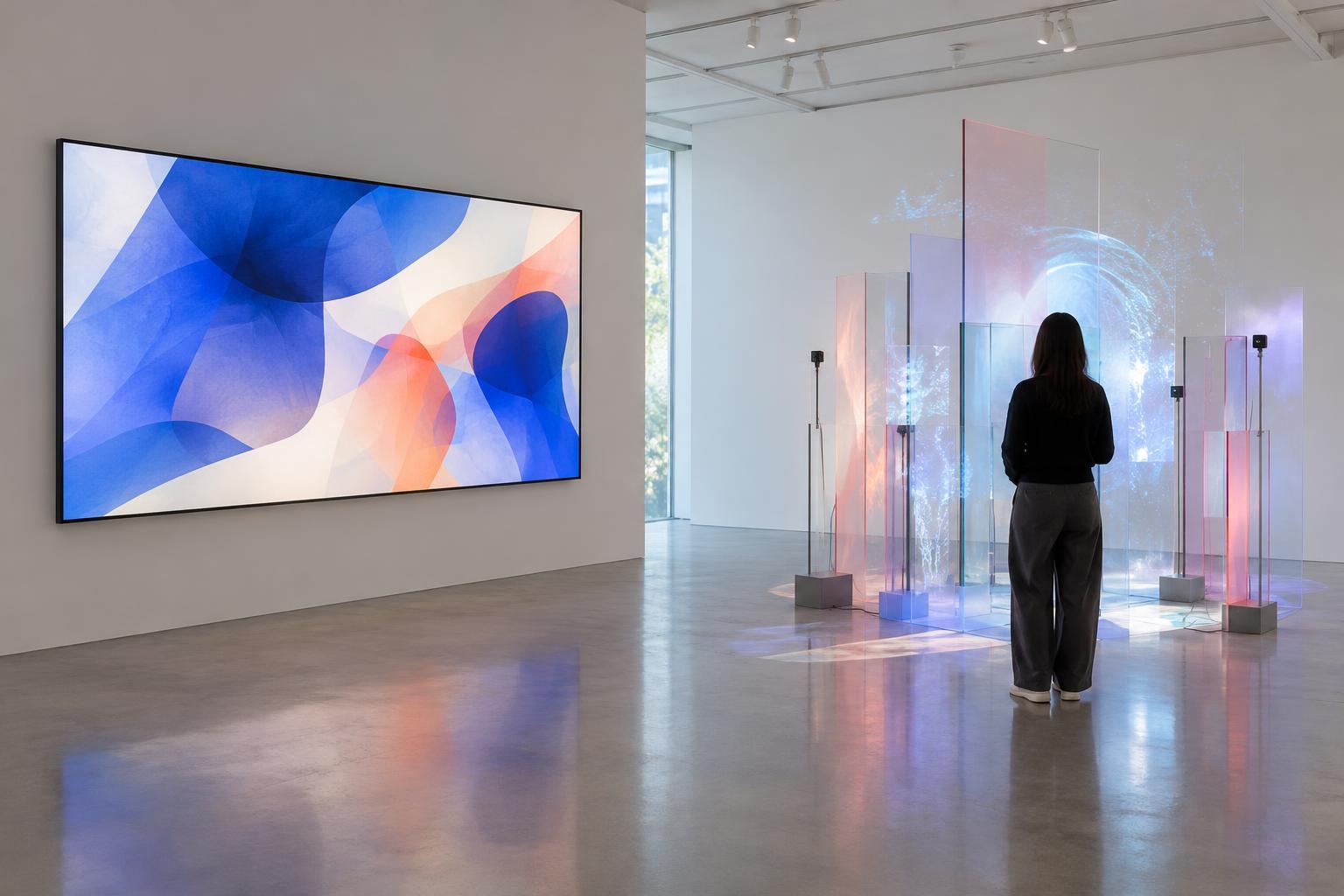
Imagine an installation in which visitors move through a room while sensors alter projected shapes and sound. It is digital if software processes the sensor input and generates the changing forms. It can also be discussed as new media art because its meaning may depend on feedback, bodily movement and the changing relationship between visitor and system. The two labels describe different aspects of the same encounter.
Now imagine a digital collage displayed as a framed print. Its layering, editing and image-making process may make “digital art” a precise description. Calling it new media art might also make sense if it engages with online circulation or the conventions of screen-based imagery, but that claim would need support from the work itself. Medium labels are most helpful when paired with a specific observation rather than used as substitutes for one.
Questions to ask instead of choosing a side
When describing a work, begin with what it does. How was it made, and which parts of that process matter to its appearance or behavior? Does it change over time? Can visitors influence it? Does it depend on a network, an interface or a particular physical space? These questions give readers a clearer picture than a category alone.
It is also worth considering what the label leaves out. An interactive projection is still an arrangement of light, scale and sound in a room; a digitally fabricated sculpture still has weight and texture. Paying attention to those qualities keeps technology from becoming the entire explanation.
Use “digital art” when digital making or presentation is central to your point. Use “new media art” when the work’s use of technological systems, exchange or participation is the more useful focus. Use both when both perspectives illuminate the work. The aim is not to settle an artwork’s identity once and for all, but to give someone a better way to look at it.