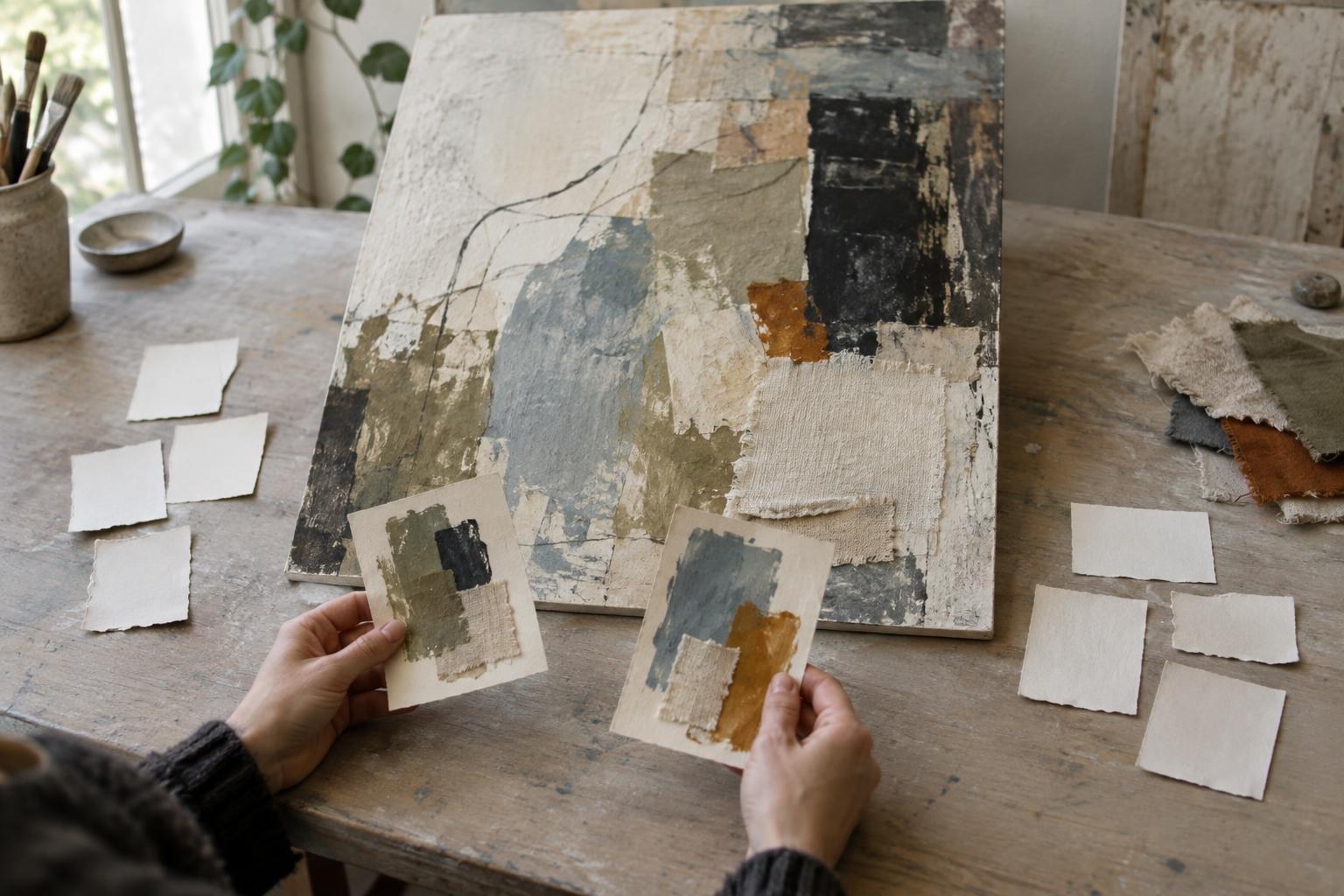
Begin with the work, not a verdict
A critique is most useful when the artist can tell what prompted your response. Instead of opening with “I love it” or “It doesn’t work,” spend a moment describing what is present. You might notice a narrow passage through an installation, repeated marks in a drawing, or a photograph placed where a viewer first enters the room. Description gives everyone a shared starting point, especially when a work is still in progress and its intentions are not yet clear.
Separate observation from interpretation. “The projected image cuts off at the corner” identifies a visible feature; “the corner makes the image feel interrupted” describes your experience of it. Both can be valuable, but they do different jobs. Stating which is which allows the artist to consider your reading without having to accept it as a fact about the work.
Make your response specific enough to use
General praise can encourage an artist, but it rarely shows them what to preserve or develop. If a material choice holds your attention, say how: perhaps the uneven edge of a sheet makes a precise grid feel less settled. If you lose interest, identify when that happens. For example, you might say that the first two objects establish a clear rhythm, while the third repeats it without changing your understanding. A precise response gives the artist something they can examine.
Specificity does not require technical vocabulary. Plain language often makes a stronger critique than an impressive label that hides your meaning. Try connecting a detail to an effect: “The low light made me approach slowly, so I noticed the sound before the objects.” The artist may not have intended that sequence, but your account offers useful information about one viewer’s encounter.
Ask about intentions without treating them as rules
Before suggesting a change, ask what the artist is trying to explore and what stage the work has reached. A rough material study may invite a different conversation from an installation being prepared for display. Useful questions include “What do you want viewers to notice first?” and “Which part still feels unresolved to you?” Such questions help direct attention toward decisions the artist is actually making.
An artist’s stated intention matters, but it need not end the conversation. If they want a space to feel open and you found the entry difficult to navigate, the gap between intention and experience may be worth discussing. Phrase that gap as a response rather than a correction: “I understand you’re aiming for openness. I felt unsure where I was allowed to walk. Is that uncertainty part of the experience you want?”
Offer possibilities rather than a replacement plan
Constructive suggestions are grounded in what you observed and leave the artist in charge of the work. Instead of prescribing “Move the screen to the opposite wall,” you could ask, “What would happen if the screen were visible later in the route?” That opens a way to test the relationship between placement and attention. For a painting, a similarly useful suggestion might be to compare how the composition feels with and without one repeated shape.
Limit the number of suggestions you offer at once. A long list can obscure the most important question, particularly when the work is exploratory. Choose one or two aspects that seem central to its aims, and explain why they caught your attention. You can also acknowledge a trade-off: making an installation easier to navigate might reduce the uncertainty that gives it energy. Naming that tension is more helpful than pretending every choice has an obvious fix.
Make the exchange useful after it ends
A critique works best as a conversation, not a performance by the person giving feedback. Leave space for the artist to clarify, disagree, or ask you to return to a particular detail. If several people are discussing the work, listen for differing experiences rather than forcing a consensus. Contrasting responses may reveal how a piece changes with viewing position, familiarity with a material, or the amount of time someone spends with it.
To close, briefly restate the observations that seem most useful: what held your attention, where your understanding shifted, and which question remains open. The artist can then decide what to test, keep, or set aside. A good critique does not take ownership of the next version. It gives the maker a clearer picture of how the work is being encountered and more deliberate options for what to do next.