The difference begins with repetition
Printmaking transfers an image from a prepared surface, often called a matrix, onto paper or another support. The surface might be a carved block, a metal plate, a screen or a smooth sheet used to hold wet ink. Because an image can be transferred more than once, it is tempting to think of every print as a copy. In practice, the artist’s choices about what remains constant and what changes are central to the work.
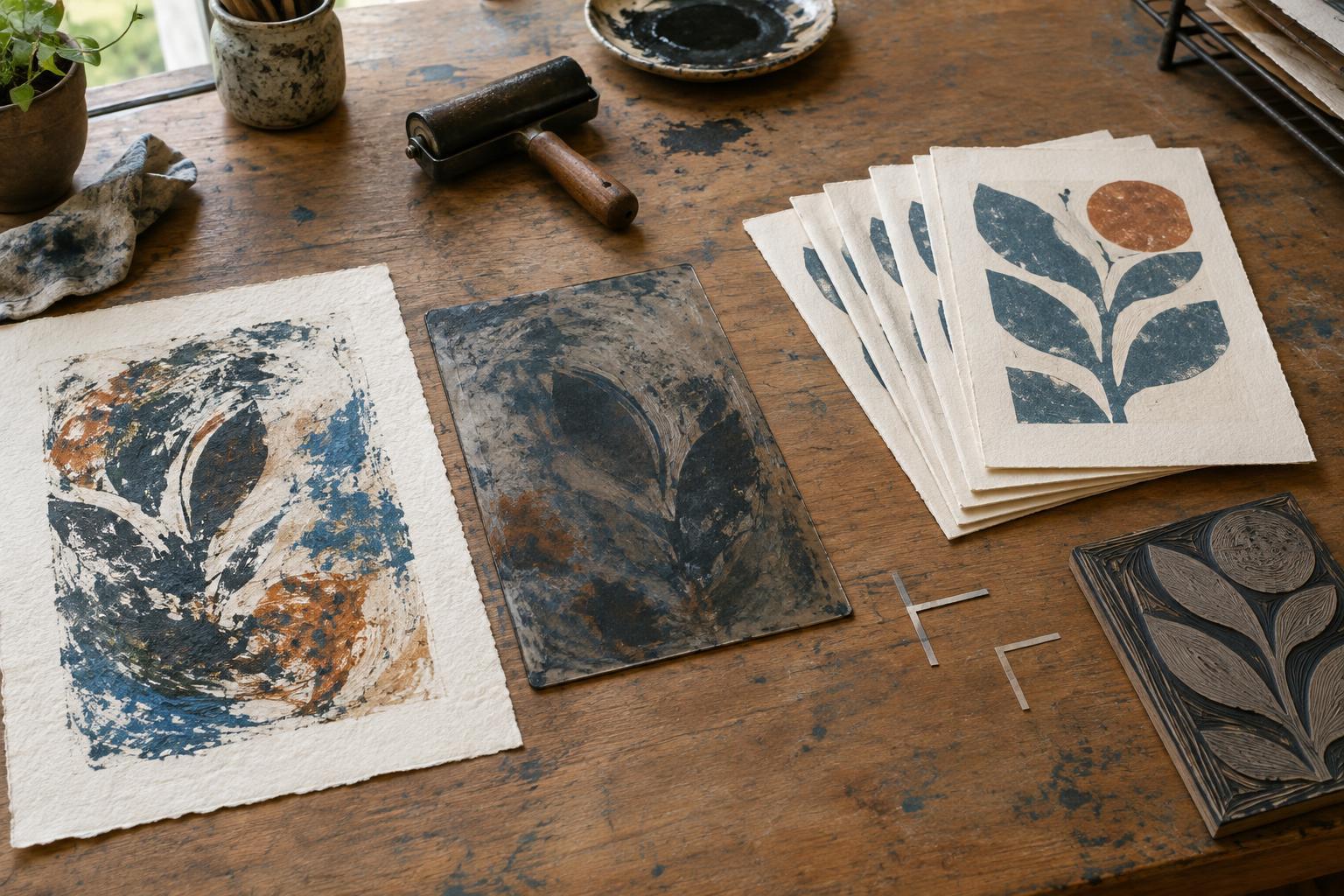
Editioned printmaking usually aims to produce a defined group of impressions from a reusable matrix. The artist may adjust inking, pressure or paper, but the edition is generally presented as a related set with a recognizable shared image. Monoprinting puts greater weight on the individual impression: even when a reusable element appears in several prints, substantial changes make each result distinct. Neither approach is inherently more original or more technically demanding. They simply make different uses of repeatability.
What happens on the printing surface
In a typical editioned process, the artist prepares an image that can withstand repeated printing. A relief block holds ink on its raised areas; an etched plate holds it in recessed lines; a screen lets ink pass through selected openings. The artist inks the matrix, places the support and transfers the image by hand or with a press. The matrix can then be inked again. Careful registration, or alignment, helps keep the image in a consistent position, especially when several colors are printed in layers.
A monoprint may start with a similarly repeatable feature, such as an etched line image or a carved shape. The artist then changes the impression by painting directly onto the plate, wiping ink away, shifting a stencil, adding another layer or altering the order of colors. The fixed feature connects the works, while the changing actions prevent them from forming a set of near-identical impressions. Pulling the print can flatten, blend or unexpectedly interrupt those marks, so the result may not look exactly like the inked surface did beforehand.
Monoprint and monotype are related, but not identical
The terms are sometimes used loosely, which can make labels confusing. In a useful technical distinction, a monoprint contains a repeatable element from a matrix, combined with changes that make the impression unique. A monotype is made from an image formed directly on a usually smooth, unmarked surface rather than from a permanently prepared image. Once the wet image is transferred, it cannot simply be re-inked in the same way.
A faint second impression, sometimes called a ghost print, may be pulled from ink left on the surface. It will not ordinarily reproduce the first image at the same strength. Artists can also work back into a print by drawing or painting on it after transfer. These possibilities show why it helps to describe the actual process instead of relying on a single label: a finished work may combine repeatable printing, one-off transfers and hand-applied marks.
How an edition is planned and described
An edition is a group of prints the artist identifies as belonging together, often with a stated number of impressions. Consistency matters, but it need not mean mechanical sameness. Handmade prints may show small differences in ink coverage, pressure or paper texture. More deliberate variations can be part of a planned series, provided the way the works are grouped and described makes sense for that project. A number written on a print tells you about its stated edition, not by itself how much handwork went into making it.
A monoprint is often identified as a unique impression, even if related prints share a base image. A group of such works may be called a series rather than an edition of matching impressions. When viewing a print, look beyond its numbering or title. Compare recurring lines and shapes, areas of hand-applied color and signs of registration. Those details can reveal which decisions were built into the matrix and which were made anew for each sheet.
Choosing a process for the idea
Editioned methods can suit an image that gains meaning through recurrence. An artist might refine a set of shapes, test how a composition reads on different papers and then print a coherent group. The repeated matrix provides a structure, while modest differences between impressions keep the material process visible. This approach calls for planning: a change made to a carved or etched matrix can affect every later impression.
Monoprinting is useful when the image depends on responsive decisions. An artist can move a stencil between pulls, let earlier layers guide new marks or treat a plate as a place to rehearse several possible compositions. To try the distinction on a small scale, print the same simple shape twice with similar placement, then print it again while changing the surrounding ink marks. Comparing the sheets makes the central question tangible: is repetition the work’s organizing principle, or the starting point for variation?