From viewing to doing
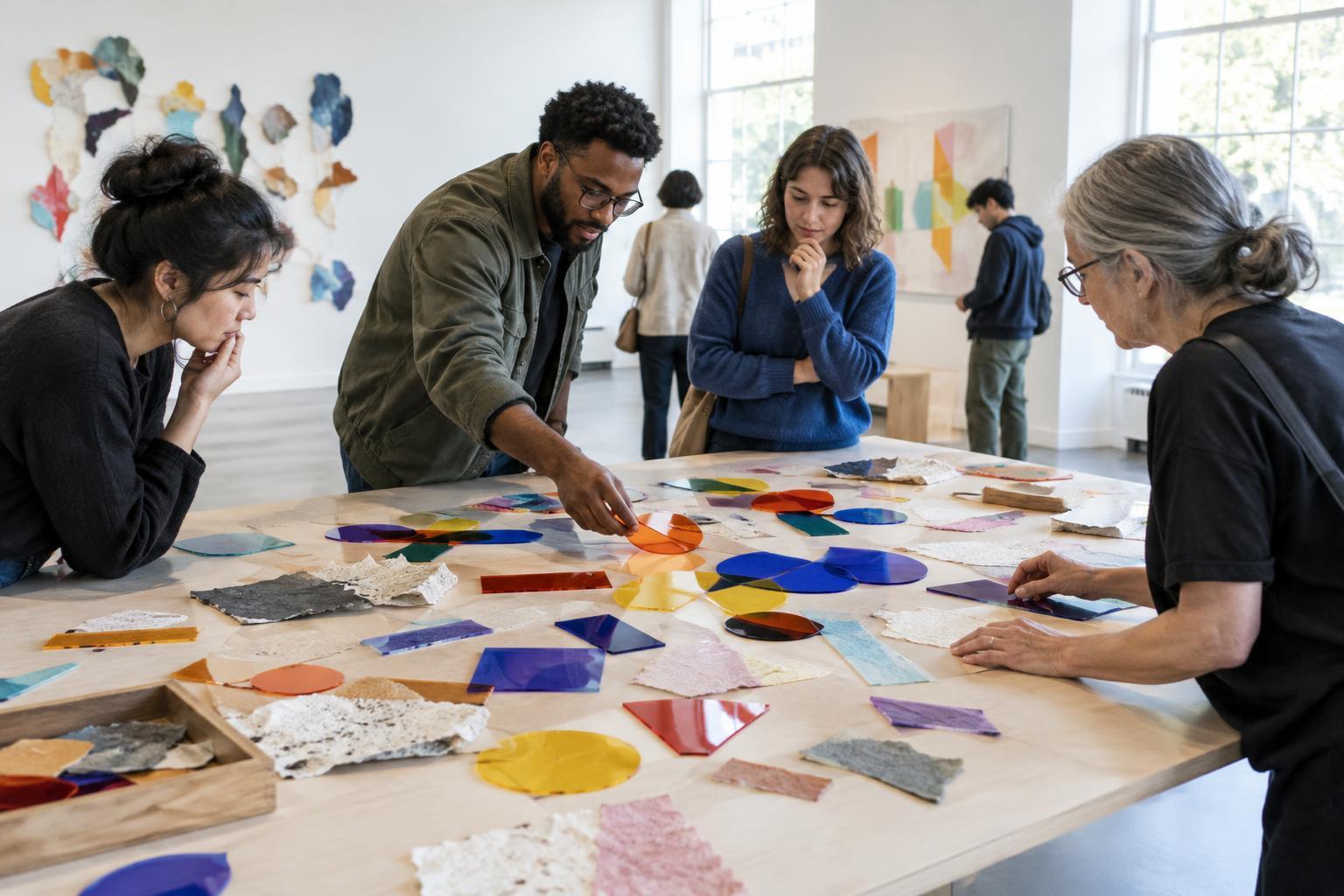
An artwork does not have to be touched to involve its audience. Looking, moving around a room and choosing where to stand all affect an encounter with art. Participatory art makes that involvement more explicit: visitors might add a mark, move an object, follow an instruction, share a story or work with other people. Their actions become part of how the work unfolds.
Participation can be modest or extensive. Placing a paper token in a container may alter an installation only slightly, while a workshop might leave its outcome largely in participants’ hands. The useful question is not simply whether a work is interactive. It is what visitors can change, how those changes become visible and whether the work would be meaningfully different without them.
The invitation sets the terms
Every participatory work begins with an invitation, even if it appears to offer complete freedom. Materials, instructions, room layout and the presence of facilitators suggest what to do. A table stocked with identical cards encourages a different response from an open floor filled with movable objects. A quiet room may make a whispered exchange feel possible; a crowded entrance may make the same request feel public.
These choices shape who feels comfortable taking part. A visitor may be eager to build something but reluctant to speak in front of strangers. Someone else may prefer to watch before deciding. Clear instructions can reduce uncertainty, while room for interpretation can invite unexpected contributions. Neither approach is automatically better. What matters is whether the invitation supports the kind of agency the artwork seems to promise.
Shared authorship has limits
When participants contribute to an artwork, authorship becomes more complicated, but it does not necessarily become equal. The artist may still choose the materials, decide which contributions remain on display and determine when the work ends. A visitor may have wide freedom within those boundaries while having little say over the larger structure. Noticing both forms of influence gives a clearer account of the work than calling it either fully open or fully controlled.
It can help to ask whose decisions endure. Are visitors’ contributions preserved, rearranged or cleared away? Can participants see what others have made? Does the work acknowledge their role, or are their actions treated mainly as raw material? These questions need not have one ideal answer. A temporary gesture can be central to an artwork. The point is to understand what kind of collaboration is actually taking place.
Participation changes the space between people
A participatory installation may produce a social situation as well as a visual one. Visitors can encounter the work through another person’s choices: a wall already covered in responses, an object moved from its original position or a task that requires cooperation. Even when participants never meet, the accumulated evidence of their actions can make the audience aware of itself.
That awareness is not always comfortable. One person’s playful intervention may limit what the next person can do; an invitation to share a personal memory may feel more demanding than expected. A thoughtful work can leave space for refusal, hesitation and observation. Watching is not necessarily a failure to participate. It may be the way a visitor considers the work’s rules and the actions of others.
Looking at what remains
Participatory art often changes over time. Its appearance at the start of an exhibition may differ from its appearance near the end, and neither view tells the whole story. Marks, worn surfaces and rearranged materials can show that actions have occurred, but they cannot fully convey each participant’s experience. Photographs and written descriptions may preserve parts of the process while leaving out its pace, uncertainty or atmosphere.
To interpret such a work, pay attention to both the visible result and the conditions that produced it. What were visitors asked to do? What choices could they make, and which were made for them? How did earlier contributions affect later ones? Participatory art shifts attention from an object alone to a relationship among people, materials, space and time. Its value may lie as much in those changing relationships as in anything left on display.