Two forms built around live action
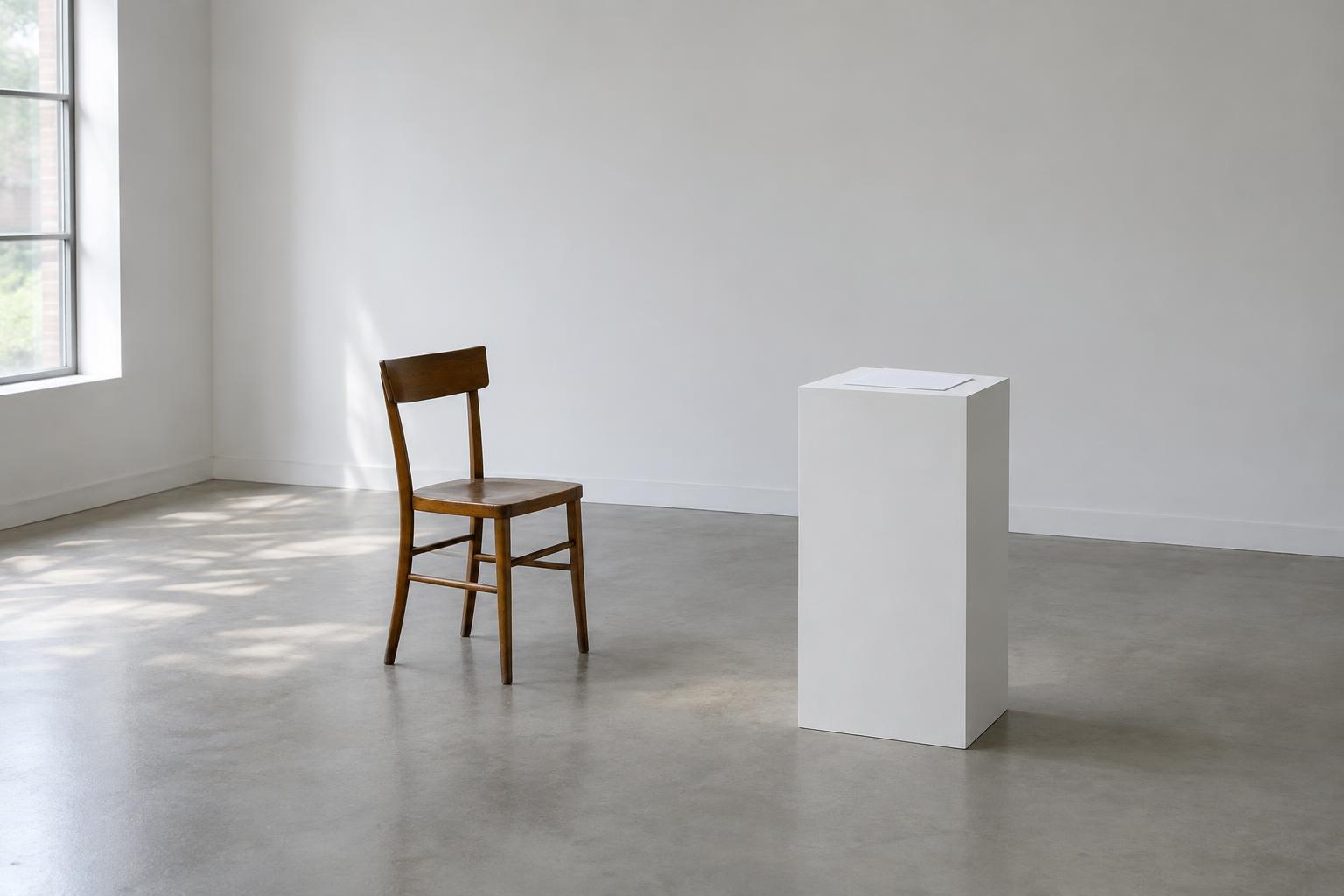
A person enters a room, moves a chair and waits. Is this performance art or theater? The action alone cannot answer the question. Its setting, the expectations offered to the audience and the ideas the work asks us to consider all matter. Theater and performance art both use bodies, gestures, sound and duration. Neither requires an elaborate set, and neither guarantees a clear story.
The distinction is most useful as a way to describe an artwork’s priorities, not as a rule for sorting every work into one category. Theater often organizes live action into a performed world, whether through characters, dramatic relationships or a sequence of events. Performance art often presents an action itself as the work, drawing attention to what it means for a particular person to do it in a particular place. Artists can borrow freely from both approaches.
Character, action and artistic purpose
In theater, a performer may speak and act as a character. Even when the staging is minimal or the plot is fragmented, audiences are often invited to follow a situation unfolding within a constructed frame. Rehearsal helps performers shape that situation so it can be presented again. The audience may ask what a character wants, how a scene changes or how the production interprets its material.
In performance art, the performer’s action may not stand for a fictional event. Repeating a simple task, holding a pose or inviting a visitor to make a choice can become a way to examine labor, attention, vulnerability or social behavior. The performer might be the artist, a collaborator or a participant; their identity can matter without making the work an autobiography. The audience may ask why this action is happening here and what its real conditions reveal.
These are tendencies, not tests. Theater can address its audience directly and expose its own construction. Performance art can use scripts, roles, costumes and rehearsals. Rather than looking for one defining feature, consider what carries the work: a dramatic situation, the conditions of an actual action, or a deliberate tension between them.
Where the work happens
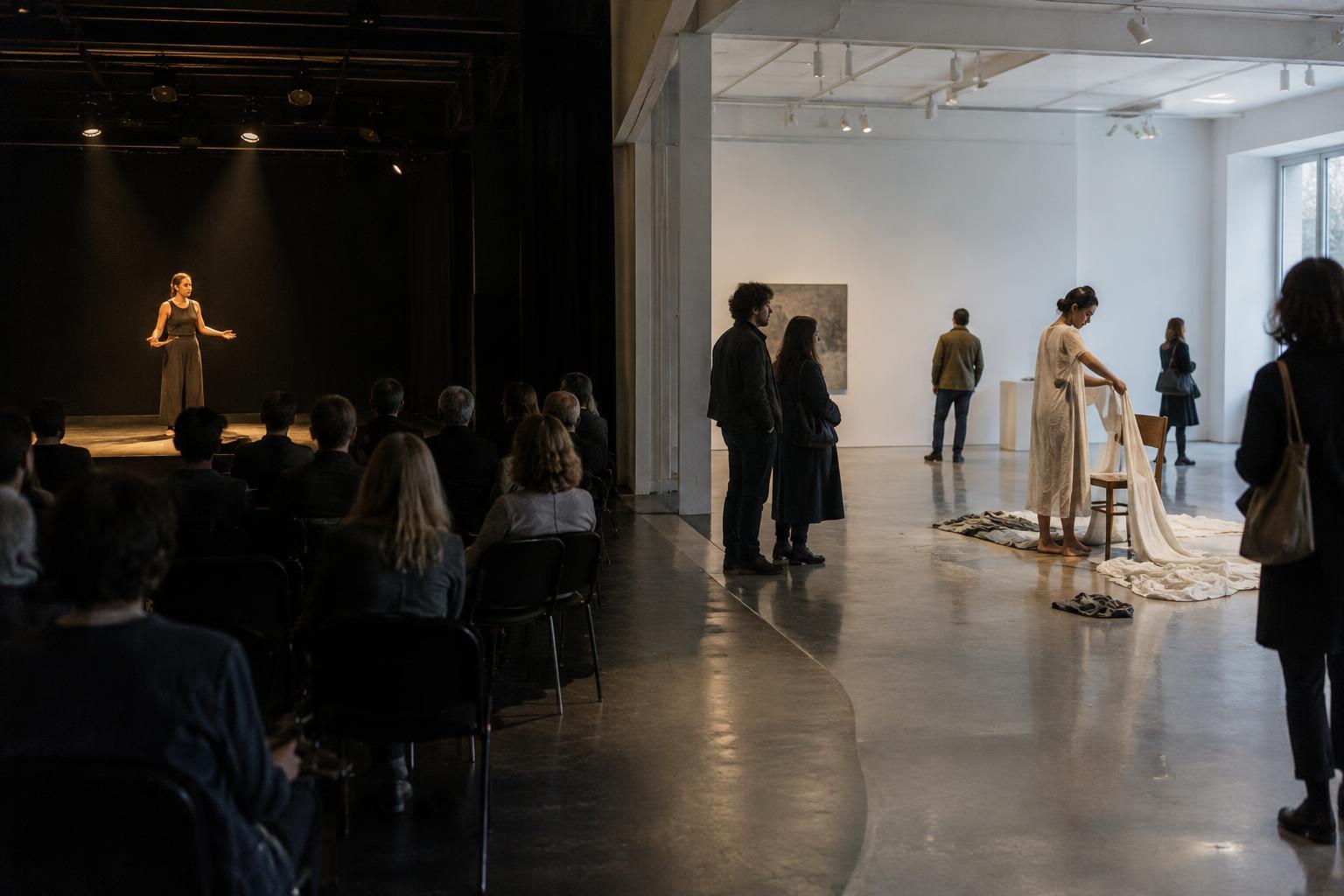
A theater space commonly gives viewers a designated place from which to watch. Lighting, seating and a scheduled start can help mark the boundary between performance and ordinary activity. Productions can challenge that boundary, but the audience usually receives some indication of when the event begins and what counts as part of it.
Performance art may take place in a gallery, on a street, online or within another public or private setting. The site can be more than a backdrop. A quiet action in a busy passageway, for example, may change how people navigate the space and decide whether to stop. In a gallery, an action can also alter how visitors encounter nearby objects. Questions of access, permission and who feels welcome in the space may become part of the work’s meaning.
Neither form belongs exclusively to a particular venue. A play can occupy a warehouse, while a performance artist can present work on a stage. The more revealing question is how the setting shapes the encounter: does it support an imagined world, draw attention to the real surroundings, or do both at once?
Time, repetition and the audience’s role
A theater production is often designed to be performed multiple times. Individual performances will vary, but a script, score or agreed structure can provide continuity. Viewers generally attend for a defined span, even if the production asks them to move between rooms or make decisions along the way.
A performance artwork may also be repeated, but duration and change can be central to its premise. An action might last long enough for fatigue, boredom or shifting attention to become noticeable. Some works allow visitors to arrive and leave while the action continues; others depend on a single, tightly timed encounter. Documentation can preserve aspects of such a work, but a photograph or recording offers a different experience from sharing its space and time.
Audience participation is not a requirement of performance art, just as passive observation is not a requirement of theater. In either form, the audience’s role may be carefully designed. A useful question is what viewers are asked to do: follow a sequence, witness an action, contribute to an outcome or notice their own response. Those invitations shape the work as much as the performers’ movements do.
A practical way to approach the boundary
When encountering an unfamiliar live work, begin with observation rather than a label. Notice whether actions suggest characters or remain tied to the performers as people in the room. Look at how the work uses its site, whether it has a repeatable structure and how it addresses those watching. Any one answer may point toward theater or performance art; the combination is more informative.
The boundary is valuable precisely because artists can cross it. A staged scene can make viewers aware of the real labor of performing, while an apparently ordinary action can develop dramatic tension. Seeing how a work handles both possibilities can be more rewarding than deciding which category owns it.