A stitch is more than a fastening
Stitching is often understood as a way to make a seam, but in an artwork it can do several jobs at once. Thread can secure one surface to another, draw a visible path, gather loose material or hold two edges slightly apart. The same stitch may be both a practical connection and a mark the viewer is meant to notice. Thinking about these roles separately can help an artist decide what the thread needs to do.
The materials on either side of a stitch matter as much as the thread itself. A line sewn through soft cloth behaves differently from one passed through paper, a thin sheet of plastic or a prepared rigid surface. Some supports yield around the needle; others retain each hole. Before committing to a larger work, a small sample can reveal whether the support tears, puckers or sits as intended.
Joining as a visible decision
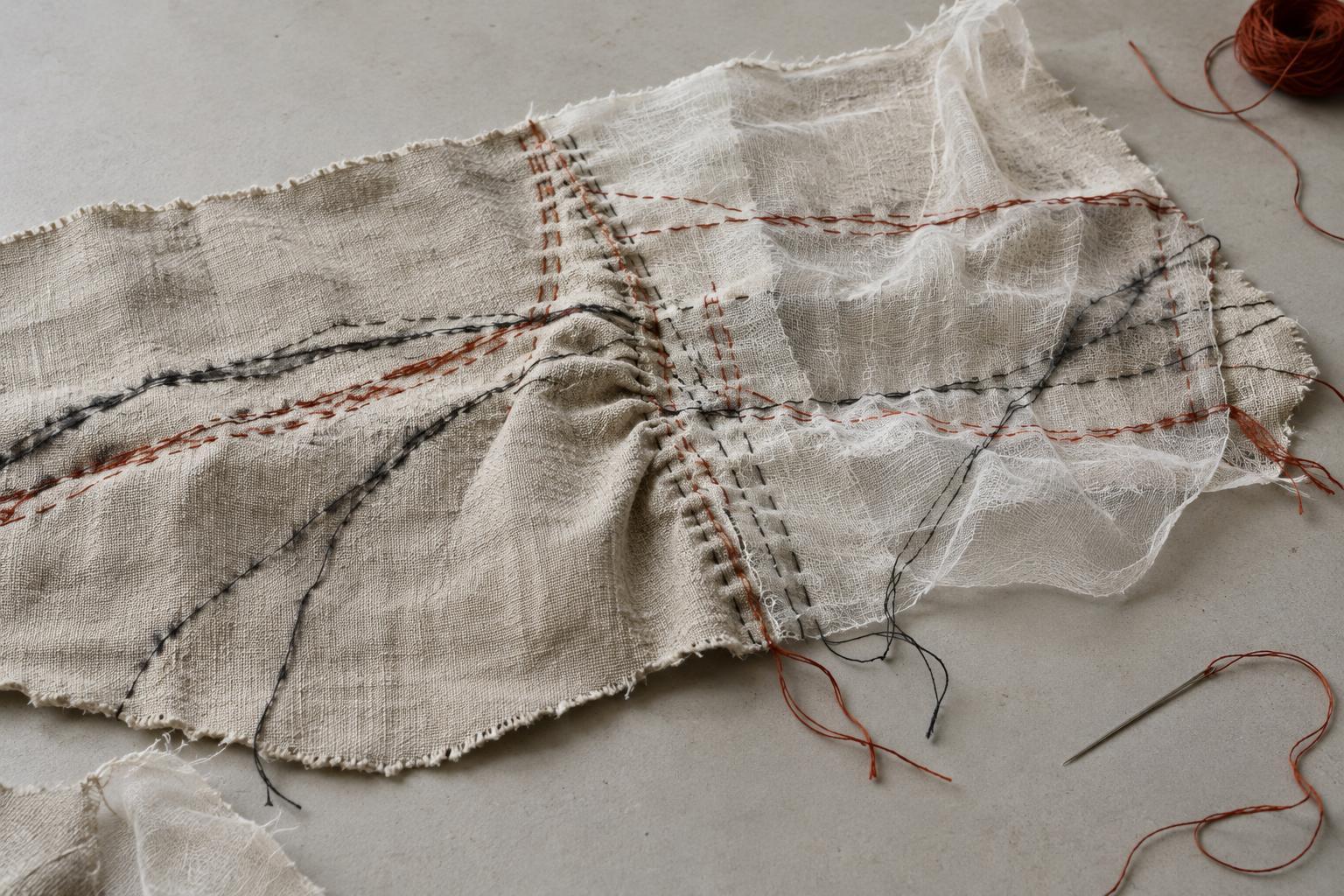
A seam does not have to disappear. Large, widely spaced stitches can show how separate pieces are being brought together. A close, regular seam may make the connection feel orderly, while uneven intervals can call attention to each point of contact. Leaving a gap between joined edges changes the effect again: the thread becomes a bridge, and the space between the materials remains part of the work.
This makes stitching useful when materials have different textures or histories of handling. Rather than hiding a boundary, the artist can let the join describe it. A heavy thread crossing a delicate surface may appear assertive; a fine thread holding bulky pieces may look provisional. Neither effect has a fixed meaning. What matters is whether the visible relationship between the parts supports the larger idea of the piece.
Thread as a drawn line
Stitches can be planned like marks on a page. A running stitch sets up a rhythm of thread and gaps. Repeated parallel lines can suggest a field or direction, while a wandering line can guide the eye across a surface. Changing stitch length interrupts that rhythm without requiring a new material. Even when the thread matches its support in color, light may catch its raised path and make the line visible from an angle.
Consider the reverse side, too. Knots, crossings and changes of direction may form a second drawing that differs from the front. An artist can conceal that side, reveal it at an edge or make the work viewable from both directions. These choices are especially useful for hanging pieces, where a viewer may move around the work rather than encounter it as a flat image.
Using tension without losing control
Thread tension affects the shape of what it passes through. Pulling tightly can gather fabric, bow a flexible sheet or bring two edges closer. A looser stitch may leave a loop that casts a shadow or allows parts to move. Tension is therefore not just a matter of neatness; it can become a way of building volume, spacing and movement into a piece.
It helps to test tension gradually. On a sample, try the same sequence of stitches with different amounts of pull and compare the results after the material has been handled or hung. Marking hole positions before stitching can make comparisons easier. If a support begins to split, widening the spacing or choosing another support may preserve the intended form better than adding more thread.
Let the method remain legible
A finished stitched work can invite viewers to follow its making. Visible starts and stops, a change in thread color or a seam that turns a corner can reveal decisions without explaining them in words. In an installation, stitches might connect elements across a wall or suspend small components in space. In a compact work, a single repaired-looking join may be enough to draw attention to the relationship between two surfaces.
The strongest approach is not necessarily the most intricate. Ask what the stitch contributes that a painted line, adhesive or hidden fastener would not. It might create a physical connection, show the time of repeated action or hold material under visible strain. When joining, marking and tension work together, stitching becomes more than decoration: it becomes part of how the artwork takes shape.